
Last updated October 16, 2026
 Wrought iron
 Wood & steel frame
 Farm & ranch
 Sliding driveway gates
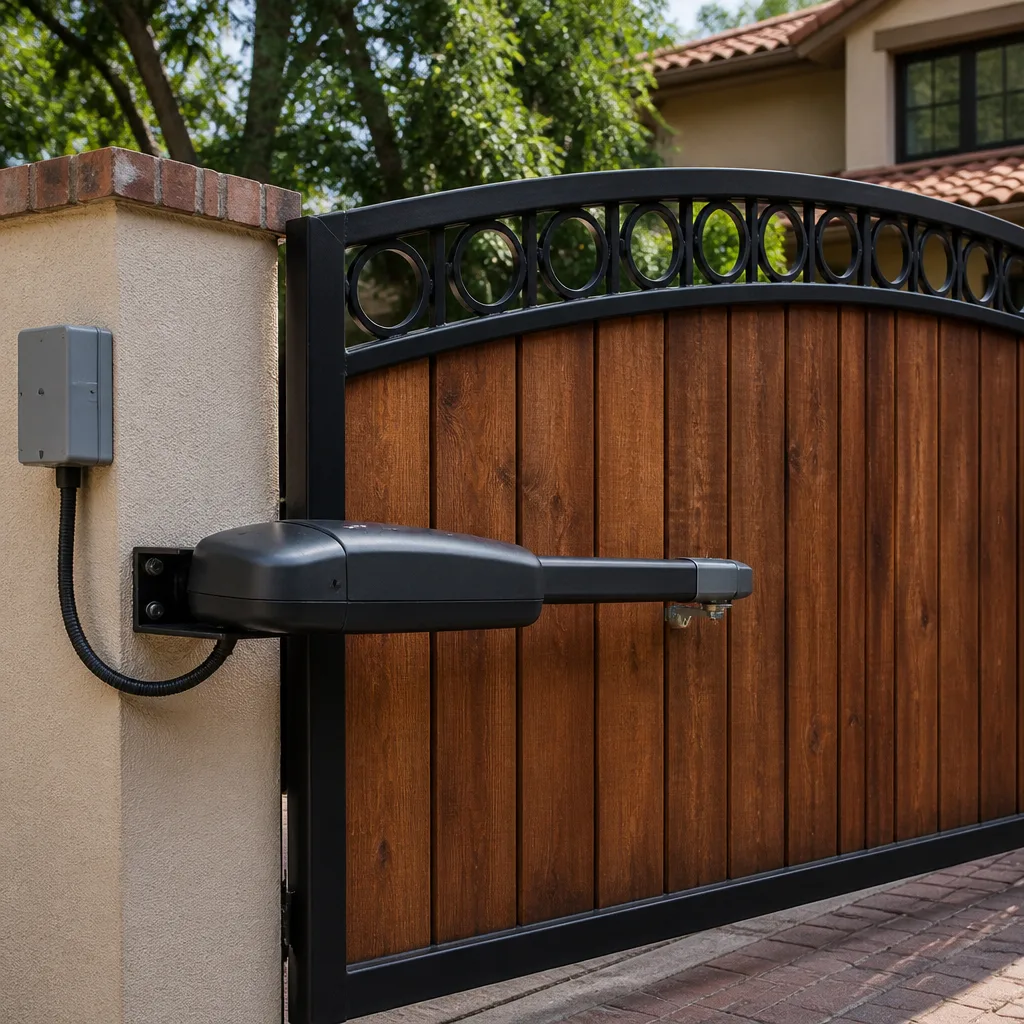 LiftMaster operators
Free on-site gate assessment - hinges, posts, and your LiftMaster or Nice gate operator checked before anything is quoted
The assessment is free and the quote is the invoice.
Get your free estimateGate Repair Warning Signs: A Torrance Homeowner’s Reference Guide
Every gate failure that leaves a Torrance homeowner locked in or out was preceded by at least two observable warning signs that were missed or dismissed as minor nuisances. A gate that hesitates for two seconds before moving isn’t ‘just slow’ – it’s a motor drawing excess current to overcome mechanical drag, and that extra load is shortening motor life every single cycle. This guide teaches you to recognize those signals by what you see, hear, and feel during normal gate operation across the streets of Southwood, Walteria, and Old Torrance, before the system fails completely.
Styles & brands we work with
Quick Answer
Gate repair warning signs in Torrance fall into five categories: new or worsening sounds (grinding, clicking, relay chatter), visible hinge wear on swing gates, unexplained speed changes in gate travel, intermittent operation that comes and goes, and control board indicator light patterns that deviate from normal. Any one of these signals, observed twice or more, means a component is degrading and will fail – scheduling a Gate Repair diagnosis before that failure costs a fraction of an after-hours breakdown repair in Torrance.
Table of Contents
- Sounds That Signal Failure: Grinding, Clicking, and Relay Chatter
- Swing Gate Hinge Wear: What to Look For at the Pivot and Latch Side
- Gate Speed Changes: Why Faster or Slower Travel Is a Diagnostic Signal
- Intermittent Failure: Why a Gate That ‘Usually Works’ Is More Dangerous
- Control Board Indicator Lights on Common Torrance Gate Brands
- Photo Eye and Loop Detector Problems: The Silent Safety Failures
- Motor Strain: Overheating, Smells, and Premature Wear
- Common Mistakes to Avoid
- When to Call a Professional
- Frequently Asked Questions
- The Bottom Line
Sounds That Signal Failure: Grinding, Clicking, and Relay Chatter
Your gate talks before it fails. The specific noise it makes points to the specific component degrading. Learn these three sounds and you’ll know what you’re dealing with before you even open the gate motor repair panel.
Grinding or Metal-on-Metal Scraping
Grinding during gate travel almost always means a mechanical component is wearing against its mating surface. On a swing gate, this is typically the hinge pin riding on a dry or worn bearing. On a slide gate, it’s usually the rollers that carry the gate leaf along the track – when those rollers freeze or flatten, the gate drags across the rail and grinds. In Torrance’s coastal air, untreated steel components corrode faster than inland. We’ve seen slide gates in the South Bay rust through their roller assemblies in under four years when they were never greased. The fix, caught early, is often a set of replacement rollers and a track alignment. Ignored, it becomes a burned-out motor that was working against constant drag.
Clicking or Popping During Operation
A single sharp click at the start or end of travel is normal on many operators – that’s the limit switch engaging or releasing. But a rhythmic clicking during travel, or a click that repeats when the gate is stationary, points to something else. On Carver Gate Repair Torrance home service calls, a repeating click with no gate movement usually means the capacitor is failing to deliver the starting torque the motor needs. The motor tries to start, the control board hears a fault, and the system clicks off. Call that an early motor capacitor failure; it’s one of the cheapest repairs a technician can make, and one of the most commonly misdiagnosed as a “dead motor.”
Relay Chatter (Rapid-Fire Clicking)
Relay chatter is a fast, machine-gun-like click sound that lasts a second or two, often when the gate is commanded to open or close. This is the control board’s relay trying to energize a circuit but not holding it. Causes include a loose wire on the limit switch, a failing transformer, or a control board that has taken a power surge. Torrance’s occasional brownouts and the salt-heavy air off the Pacific are both hard on control boards. If you hear relay chatter once, note it. If you hear it twice in the same week, the component causing it is revealing itself, and a service visit now beats a dead gate later.
Swing Gate Hinge Wear: What to Look For at the Pivot and Latch Side
Swing gate hinges fail gradually, and the earliest signals are visual. You don’t need any tools to spot them – just a willingness to look at your gate the way a technician would, with attention at two specific points.
At the Pivot Point (The Hinge Post Side)
Stand at the hinge post and look at the gap between the gate leaf and the post. The gap should be consistent from top to bottom. If it’s wider at the bottom than the top, the hinge pin or the hinge itself is wearing unevenly. That uneven wear means the gate’s weight is now levering against the top hinge, which will accelerate the failure. You may also see a fine rust-colored powder at the hinge, which is the metal grinding itself down. On gates we inspect around Torrance, particularly in the older neighborhoods west of Crenshaw, powder at the hinge pin is the single most common sign that a gate is within months of a structural hinge failure.
At the Latch Side (The Free-Swinging Side)
Look at how the latch side of the gate sits against the latching post. If the gate hangs low, so the latch no longer lines up with the strike plate cleanly, that’s hinge sag. The homeowner response is often to lift the gate by hand each time, which is a stopgap, not a repair. Each lift adds stress to the same worn hinge. The correct fix is hinge replacement and, if the post has shifted in the soil, a post anchoring evaluation. Torrance has expansive clay in parts of the city, and clay expands and contracts with moisture. A gate post that moves seasonally is a post that will eventually pull a hinge out of alignment permanently.
What These Cues Mean in Sequence
- Fine rust powder at the hinge pin or hinge surface – component is grinding itself down.
- Uneven gap between gate and post – hinge wear is now structural.
- Gate sagging at the latch side – hinge has exceeded its load capacity.
- Latch no longer lines up cleanly – imminent failure, or a gate that can be forced open.
We recommend checking both pivot points and the latch alignment once a month. It takes 30 seconds, and it tells you which side of the system is carrying too much load. For a deeper look at what a proper Gate Repair in Torrance inspection covers, see our full service page.
Gate Speed Changes: Why Faster or Slower Travel Is a Diagnostic Signal
Your gate’s travel speed is set at installation and should remain consistent. A gate that speeds up, slows down, or varies speed during travel is not acting quirky – it’s reporting a fault through its own motion.
Slower Than Normal
A gate moving slower than its set speed means the motor is working harder to achieve the same movement. Common causes: failing run capacitor (reduced torque), worn gearbox in the operator, binding hinge or roller, or low voltage at the operator. In Torrance’s older housing stock, where many gates were installed in the 1990s and early 2000s, we regularly find gearboxes that have run for two decades with no lubrication. The gate slows, then the motor runs hot, then the thermal overload trips and the gate stops entirely. The speed drop is your warning – usually weeks before the complete failure.
Faster Than Normal
Speed increases are rarer and more serious. If a gate moves faster than it used to, something is no longer providing the expected resistance. On a swing gate, this can mean a pivot bearing has failed and the gate is free-swinging without control. On a slide gate, it can mean the chain or belt has jumped a sprocket and the gate is no longer being held by the drive system properly. Faster travel on a gate is dangerous – a gate that free-falls through its closing arc can cause injury, and a slide gate that runs uncontrolled can derail. If your gate starts moving faster, treat it as a safety issue and call a technician the same day.
Variable Speed Within a Single Cycle
A gate that starts at normal speed, then lags mid-travel, then surges, usually has a mechanical binding point somewhere along the track or hinge arc. Think of it as a car with a flat spot on a tire – every revolution hits a dead spot. On slide gates, a flat or worn wheel is the most common cause. On swing gates, it’s a hinge that binds at a specific angle. Either way, the inconsistent travel is diagnostic: it tells you the problem is mechanical, not electrical, and it’s positioned at a specific point in the gate’s travel path.
Intermittent Failure: Why a Gate That ‘Usually Works’ Is More Dangerous
A gate that fails every time it’s used is predictable, and predictable failures get fixed. A gate that fails occasionally is worse – it makes homeowners doubt their own observations. “It worked fine this morning.” “It was the remote, it always is.” The inconsistent gate trains you to accept failures as normal variation. That’s exactly the situation that leaves a Torrance homeowner stuck outside their own driveway at 11 p.m., or worse, with a gate that decides to close on a car.
What Intermittent Failure Points To
- Failing capacitor or starting circuit: The gate works when the motor is warm, fails when it’s cold (or the reverse).
- Loose wire at a limit switch or safety input: Vibration makes the connection, then breaks it.
- Photo eye misalignment: The safety beam intermittently sees an obstruction when temperature or humidity changes. Torrance’s morning marine layer can condense on the photo eye lens, and the gate interprets the fog as a person in the path.
- Remote or receiver fatigue: The opener board is fine, but the remote battery or the receiver antenna has degraded. On older Viking and DoorKing systems installed around Torrance, receiver chips fail gradually – they work from 10 feet, then 5 feet, then only when you’re right at the keypad.
- Surge-damaged control board: The board works until a specific function is called, then reboots. The failure shows as a gate that works fine manually but not automatically.
The danger in “usually works” is that it postpones the diagnosis. By the time the gate fails completely, the root cause has often multiplied into secondary damage. A worn capacitor that was a $60 part becomes a $400 motor replacement. A misaligned photo eye that should’ve been a 20-minute adjustment becomes a bent gate leaf. Consistent trouble beats intermittent trouble, because the consistent problem tells you exactly where to look.
Control Board Indicator Lights on Common Torrance Gate Brands
Most modern gate operators have a control board with diagnostic LEDs that report the system’s health in real time. Learning to read them is one of the cheapest diagnostic skills a homeowner can pick up, and it works across the brands we service most often around Torrance.
DoorKing Indicator Patterns
DoorKing boards, common on older South Bay installations, use a single red LED on the control board. The flash sequence is the diagnostic:
- One flash, pause, repeat: Limit switch fault. The board doesn’t know the gate’s position.
- Two flashes, pause: Safety loop or photo eye fault. The board sees an obstruction signal.
- Three flashes, pause: Motor overload or thermal trip. The motor is drawing too much current.
- Steady light, no operation: The board has power but is not receiving a command. Check the remote, keypad, or push-button input.
Viking Indicator Patterns
Viking operators use both a power LED and a diagnostic LED. On most Viking boards, a solid green power light with a blinking red diagnostic light means the board is receiving power but has logged a fault. The number of red blinks between pauses corresponds to the fault code. Common codes on Viking systems installed in Torrance: limit switch fault (usually reading as 3 blinks), gate travel obstruction (4 blinks), and entrapment sensor activation (5 or 6 blinks, depending on the board revision). The specific code list is on the inside of the control box cover.
Ghost Controls Indicator Patterns
Ghost Controls systems, popular on newer automatic gates in Torrance, are self-monitoring. The system’s LED shows a steady green when the gate is at rest and operating correctly, amber when the battery is charging or the system is learning, and red when a fault has been logged. Ghost Controls systems also work with the brand’s mobile app, which reports the specific fault on the phone screen. This is one of the easier systems for a homeowner to self-diagnose, because the app translates the flash code into plain language.
Elite Indicator Patterns
Elite gate openers use a board-level LED that flashes in sequence for diagnostics. The most common pattern on Elite systems in Torrance is a repeating double-flash, which indicates a photo eye obstruction or misalignment. Single flash indicates a limit switch problem, and a steady light with no motor response usually means the run capacitor has failed. When in doubt, the LED pattern is the first thing we record on our own service calls, because it narrows the diagnosis before we touch a wrench. If you can read off the flash pattern over the phone, you’ll get a more accurate initial diagnosis from any repair company, including ours.
Photo Eye and Loop Detector Problems: The Silent Safety Failures
Photo eyes and loop detectors are the gate’s safety systems, and they fail in ways that don’t make noise and don’t stop traffic. That’s what makes them dangerous – they degrade silently, and the first symptom is the gate doing something it’s not supposed to do.
Photo Eye Misalignment
The photo eye, typically mounted on the gate post, sends an infrared beam to a reflector or a receiver. If that beam is interrupted, the gate is supposed to stop or reverse to avoid trapping someone. The problem is that photo eyes fall out of alignment slowly. Every time a delivery truck brushes the gate post, or a Torrance Santa Ana wind event shakes the mounting, the beam drifts a little. At first, the gate hesitates mid-close. Then it reverses for no visible reason. Then, when the beam finally fails completely, the gate may refuse to close at all – or worse, the beam fails in a way that leaves the gate thinking the path is clear when it isn’t.
The fix is realignment, which is a quick job, but the homeowner has to recognize the symptom: a gate that reverses mid-close, or stops and then continues, is a photo eye drifting out of alignment. It’s not a poltergeist.
Loop Detector Failures
Loop detectors are the buried wire loops in the driveway that sense the metal mass of a vehicle. When you drive up, the loop tells the gate to open. When you drive through, the loop tells the gate to stay open so it doesn’t close on your car. A failing loop detector shows up in two ways: the gate doesn’t open when you drive up, so you’re reaching for the remote while blocking the sidewalk, or the gate closes too aggressively behind a vehicle because the loop isn’t registering the car passing through. In heavier Torrance traffic corridors, a failed loop detector is also a safety issue for pedestrians, because the gate isn’t sensing the car and may close on the next person walking through.
Loop detector issues are electrical, not mechanical, and they’re best handled by a technician with a loop tester. Buried loops can also be severed by tree roots or by the same soil expansion that shifts gate posts in Torrance’s clay-heavy neighborhoods. For more on what’s involved in a full-service call, see our gate repair in Torrance coverage.
Motor Strain: Overheating, Smells, and Premature Wear
Gate motors are not designed to run hot. They’re designed for intermittent duty – a few seconds of operation per cycle, many cycles per day, but never continuous. When a motor is working against mechanical drag, a failing gearbox, or a binding gate leaf, it runs hotter than it should. Heat is the motor killer, and the signs of heat show up in ways a homeowner can detect.
The Smell Test
A hot motor has a smell. It’s not sharp like burning rubber, and it’s not acrid like an electrical short – it’s more like warm plastic or hot oil. If you’re near the gate operator after it has run several cycles and you catch a whiff of something that wasn’t there before, the motor is running hot. The smell comes from the motor’s varnish insulation beginning to break down, and by the time you smell it, that insulation has already started to degrade. This is a call-us-today situation, not a wait-and-see.
The Thermal Overload Cycle
Every gate motor has a thermal overload protection circuit. When the motor exceeds its temperature threshold, the circuit trips and shuts the motor down. The gate then won’t operate until the motor cools, which might be 10 minutes or 2 hours. If you notice a pattern – the gate runs fine in the morning, then stops working in the midday heat, then works again in the evening – that’s the thermal overload cycling. In Torrance’s summer months, when afternoon temperatures climb into the 80s and 90s in the inland parts of the city, a marginal motor will trip reliably every hot afternoon. The fix is to address the root cause of the strain before you’re forced into an gate installation in Torrance replacement.
Motor Hum Without Movement
When you command the gate to open and the motor produces a low hum but the gate doesn’t move, the motor is getting power but the starting circuit is failing, or the gearbox is seized. The hum is the motor trying to turn against locked resistance. Holding the remote button longer won’t help, and it will burn the motor windings. Release the button, note the symptom, and call for service. This is one of the most common failure modes we see on older operators around Torrance, and it’s the one that turns a $120 capacitor replacement into a $900 motor replacement when the homeowner keeps pressing the button.
Common Mistakes to Avoid
- Treating a slow gate as a personality trait. A gate that moves slower than it did six months ago is not settling in. It’s degrading. Every week it runs slow, the motor runs hotter, and the eventual repair gets more expensive.
- Lubricating the wrong parts. Spraying WD-40 on a gate hinge feels productive but washes out the bearing grease and accelerates wear. Gate hinges need the correct grease, not a penetrating oil.
- Resetting the breaker repeatedly. If the gate trips a breaker, that’s the circuit doing its job. Resetting it without investigating the cause means the next trip could be a fire, not an inconvenience.
- Ignoring a reversing gate. A gate that reverses mid-close is reporting a photo eye or safety edge problem. Letting it go means accepting a gate that could close on a child, a pet, or a car.
- Adjusting the limit switches to “fix” a sagging gate. When a swing gate sags and the latch stops aligning, the right fix is the hinge, not re-teaching the operator’s travel limits. Changing the limits just makes the system accommodate the same fault.
- Waiting for total failure to call. The cheapest gate repair is the one scheduled when the warning sign appears. The most expensive is the one scheduled when the gate is already dead and the car is blocked in the driveway.
When to Call a Professional
Some gate issues are worth watching; some are worth a service call. Call a professional when the gate reverses mid-close, when the motor is hot to the touch or smells, when the gate speed has changed and stayed changed for more than a week, when you hear grinding or relay chatter more than once, or when the gate has failed intermittently two or more times in a single week. These are not adjustment scenarios. These are component failures in progress. On any of these calls, Carver Gate Repair Torrance provides a written price before work begins, and every repair carries a written 365-day guarantee. If you’re in Torrance and you’re seeing any of the warning signs in this guide, call (424) 757-9824 for a free estimate, and we’ll dispatch a background-checked, uniformed technician to the address.
Frequently Asked Questions
Gate repair in Torrance typically runs between $180 and $750, depending on the component. A capacitor replacement is usually under $200, a limit switch or photo eye alignment typically $150 to $300, a full motor replacement $600 to $1,200, and a complete operator swap $1,400 to $2,800, including labor. The exact number depends on the gate brand, the age of the system, and whether parts are locally available. Carver Gate Repair Torrance always provides a written price before any work starts. Call (424) 757-9824 for an exact quote – estimates are free.
A gate that opens but won’t close is almost always a safety circuit issue – the photo eye is misaligned or blocked, or the loop detector is sending a false vehicle-present signal. The board thinks there’s an obstruction in the gate’s path, so it refuses to close. That’s the system doing exactly what it’s designed to do, which is a good thing, but the underlying fault still needs to be cleared.
A properly maintained gate motor in Torrance should last 10 to 15 years, but the coastal air and temperature swings cut into that. Salt corrosion on the operator housing and seasonal clay movement at the gate posts both shorten motor life. For maintenance tips, read our Seasonal Gate Repair Care for Torrance: Year-Round Homeowner’s Guide. If your gate motor is older than 12 years and starting to show the warning signs in this guide, budget for a replacement rather than repeated repairs.
Many repairs are same-day when parts are in the technician’s truck, and Carver Gate Repair Torrance carries common components for the gate-motor brands most installed around Torrance. Some niche parts, like older Viking replacement boards, may need to be ordered, which adds a few days. We’ll tell you which scenario applies before we leave, and give you a written price either way.
A gate that reverses mid-close is triggering the entrapment protection system: the photo eye is seeing an obstruction, the safety edge is activating, or the loop detector is reading a vehicle in the path. It’s a safety feature operating correctly, and the right response is to find out which sensor is tripping, not to bypass the safety system.
For most gate repairs, no permit is required in Torrance; the city treats component replacement and like-for-like repair as maintenance. But if the repair involves running new electrical to the operator, or if you’re replacing a gate that fronts a public right-of-way, a permit may be required. Your technician should confirm which applies before starting, and the written quote should state it plainly.
The Bottom Line
Gates don’t fail without warning. They grind, they slow down, they reverse, they chatter, they smell hot, and they sag at the hinge. Each of those signals is the gate telling you which component is going to fail and roughly when. A Torrance homeowner who learns to read those signals can schedule a repair on a Tuesday morning instead of being locked out on a Saturday night. Watch your gate the way you watch your car’s dashboard: not obsessively, but enough to notice when something changes. When something changes, call a professional. The written price is free to get, the repair carries a 365-day guarantee, and the alternative – waiting for the loud, expensive, inconvenient failure – costs more every time.
Written by Lonnie Burke, Owner at Carver Gate Repair Torrance, serving Torrance since 2008.
See the difference
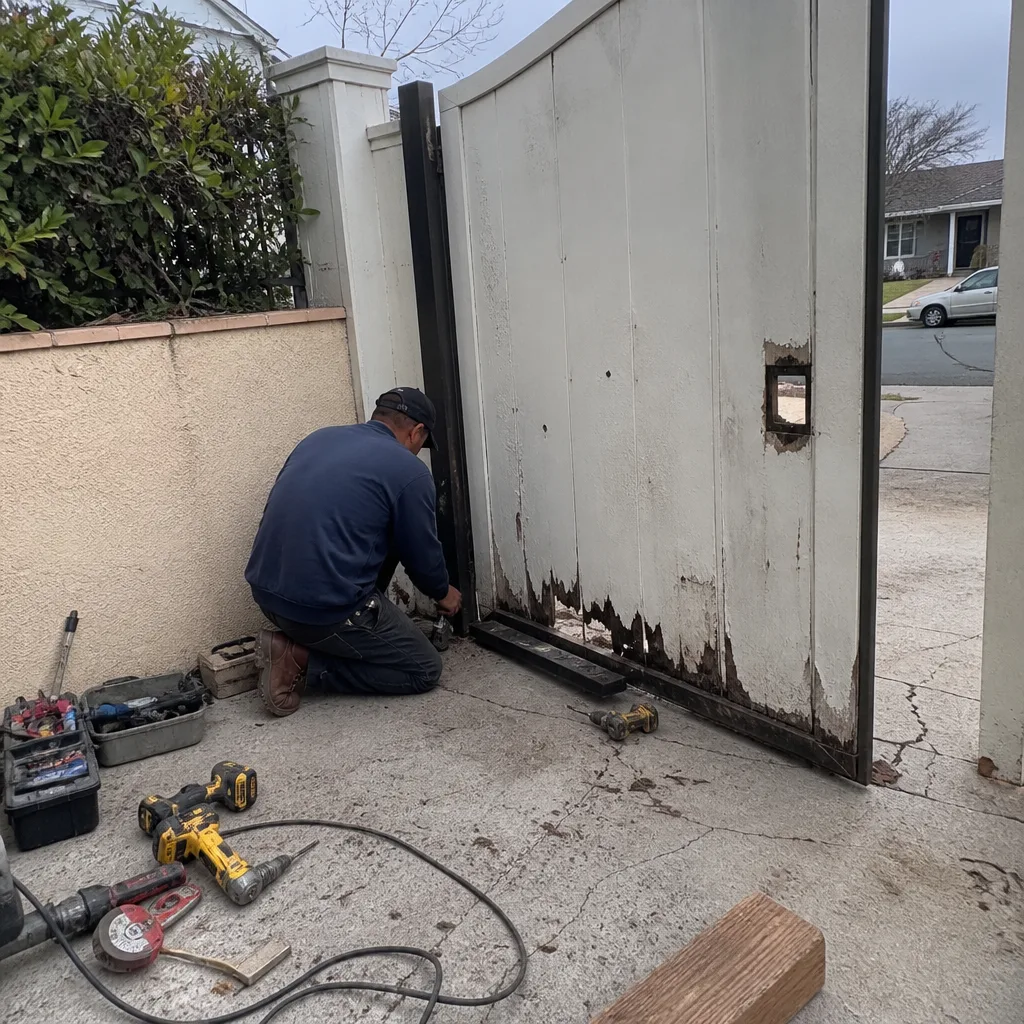 Before
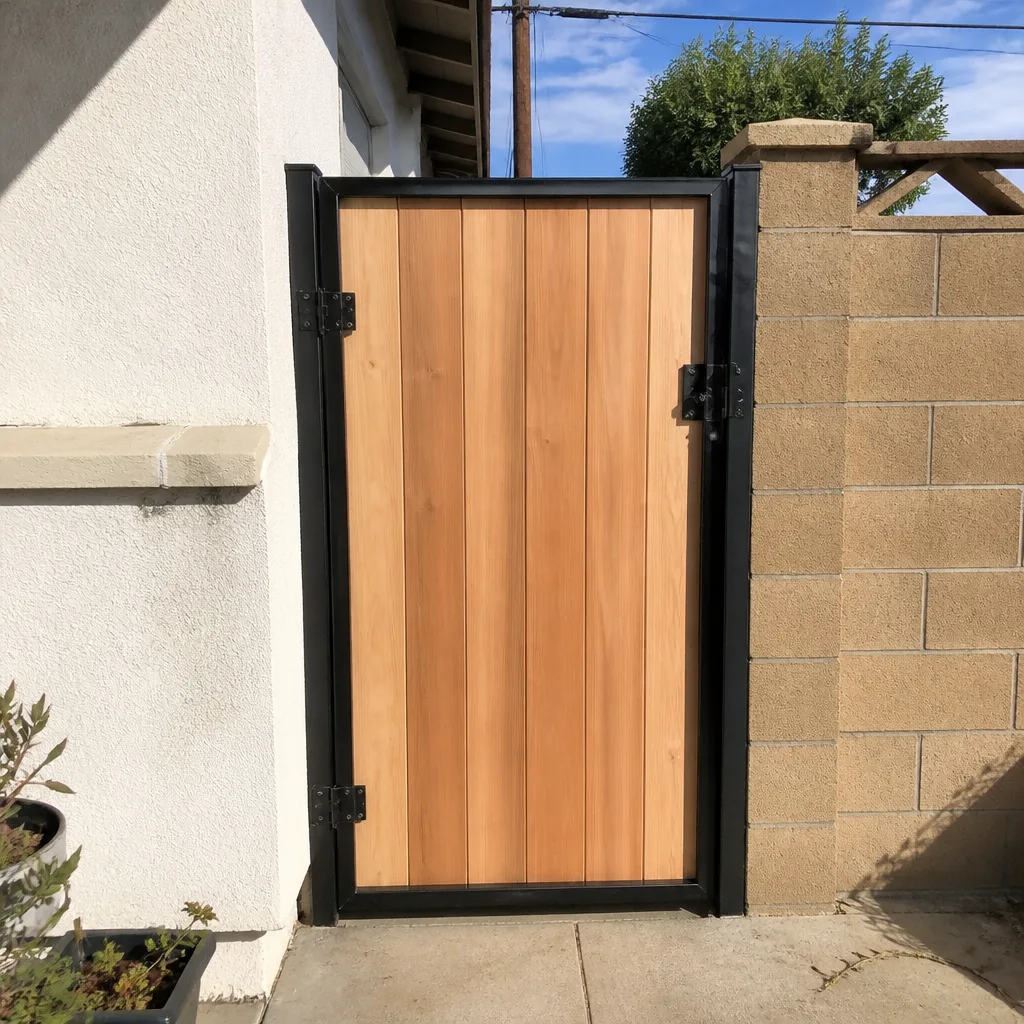 After
After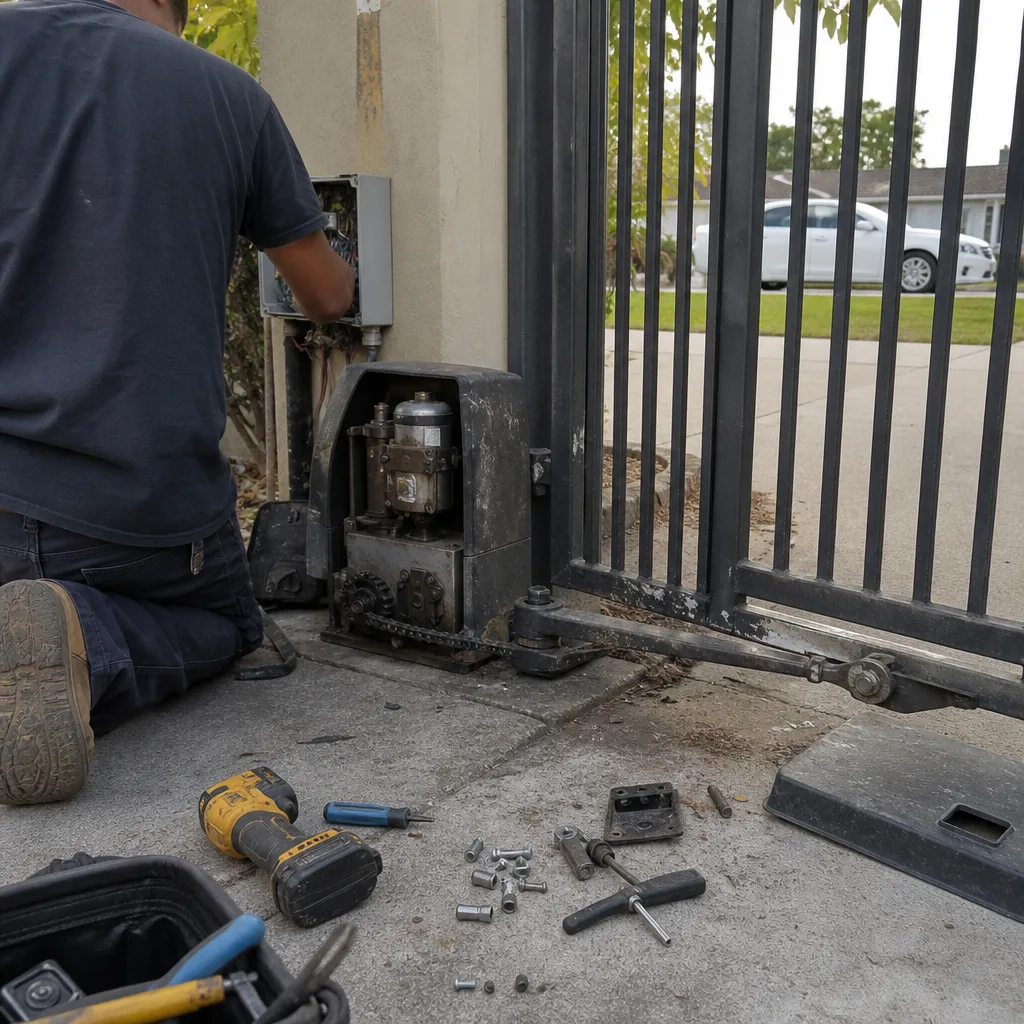 Before
 After
After Before
 After
After